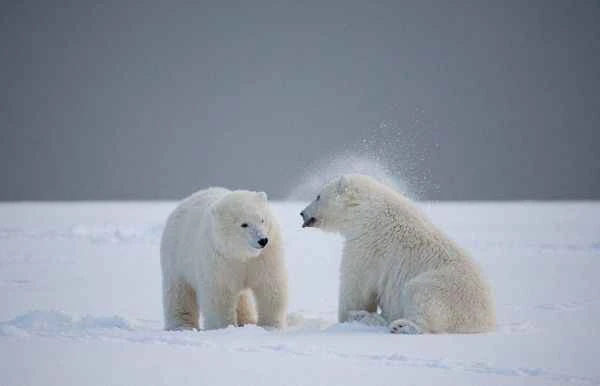
1. February 27th of each year is "International Polar Bear Day".
2. The Latin word for polar bear is "ursus maritimus". Translated, "ursus" means "bear" and "maritimus" means "of the sea".
3. These beautiful polar bears can be seen in North America and Eurasia, and most of them live in the polar regions north of the Arctic Circle.
4. Some polar bears have been found migrating south to Alaska and Hudson Bay in Canada.
5. Although they may venture inland up to 199 kilometers from the coastline, most of them live near the coastline or on the ice during the winter.
6. As the seasons change and the ice melts, they migrate within their individual "ranges." These ranges typically range from 129,499 square kilometers to 349,648 square kilometers.
7. In a year, a polar bear travels an average of more than 2,896 kilometers to hunt for food.
8. When moving on ice, polar bears can jump over cracks up to 5.8 meters wide.
9. Polar bears are the only bear species that can be considered marine mammals because they spend most of their time on sea ice.
10. Their skin is actually black. They appear white because their fur is translucent, and the reflected light makes them appear white.
11. Their paw pads are covered with fur, which not only keeps them warm but also prevents them from slipping.
12. When in water, polar bears can swim at speeds of up to 9.6 km/h.
13. Polar bears can swim for hours or even days at a time. Many people think this is impossible because they are not fish, but because of their large paws, they can use their forelegs as oars and their hind legs as rudders to control direction. This allows them to conserve energy and swim for long periods without getting tired.
14. Although they spend half their time hunting, their success rate is very low, less than 2%.
15. Their main prey includes seals, bearded seals, and some smaller animals such as birds. When necessary, they will also scavenge animal carcasses, eggs, and plants for sustenance.
16. Polar bears are considered "hypercarnivores," meaning that meat makes up more than 70% of their diet.
17. Have you ever heard of the grizzly bear or the Pizzly Bear? This species was discovered in genetic testing in 2006. They are hybrid offspring of North American grizzly bears and polar bears.
18. Only polar bears can produce these hybrid offspring. They have the same lifestyle as polar bears, but their fur is brown.
19. As of now, the wild polar bear population is approximately 26,000, divided into 19 subspecies. Unfortunately, only one subspecies is showing an upward trend, five subspecies are stable, four are declining, and the status of the remaining nine is unknown.
20. The average weight of a male polar bear is equivalent to that of 10 adult men, approximately 800 kilograms.
21. Polar bears can grow up to 3 meters long, making them the largest terrestrial carnivores in the world.
22. Female polar bears are about half the size of males.
23. Polar bears have an extremely sensitive sense of smell, capable of detecting prey up to 1 kilometer away. They use this sense to locate the breathing holes of seals on the ice.
24. Polar bears will locate a seal's breathing hole and wait nearby. When the seal surfaces to breathe, they will attack. This is also known as "ambush hunting."
25. Polar bears can detect the presence of seals in the water, even when the ice is covered with 3 feet of snow.
26. If needed, they can also be extremely fast. When ambushing prey, they can strike from 15 to 30 meters away, reaching speeds of up to 40 kilometers per hour.
27. Tragically, polar bears are among the first species threatened by climate change, and their population is projected to decline by 30% by 2050.
28. There are many modern technologies for tracking animals, but in recent years WWF has discovered that polar bear DNA can be collected from paw prints left in the snow. With just a few steps, SPYGEN's DNA experts can isolate polar bear DNA from the snow.
29. Unless pregnant, polar bears are the only bear species that do not hibernate during the winter. Sometimes, if the weather is extremely cold, they will dig dens and go inside to hibernate temporarily. This is also known as Carnivore lethargy (carnivore lethargy).
30. The largest polar bear on record was discovered in northern western Alaska in 1960, weighing an astonishing 1,002 kilograms.