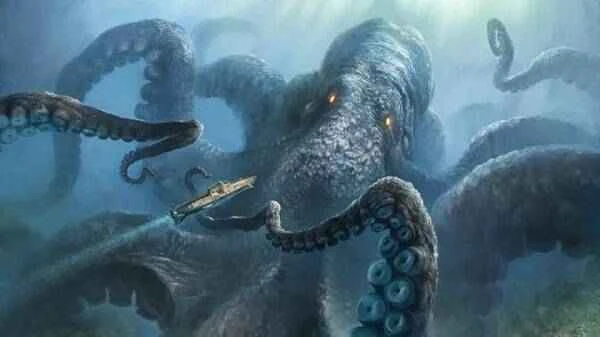
The giant squid, also known as the colossal squid, is not actually a cuttlefish, but a cephalopod mollusc belonging to the family Colossidae and the genus Colossus. It is the second largest member of the subclass Octopoda, after the mesoceratops, reaching a total length of 13 meters and a maximum weight of 275 kilograms. It inhabits a wide range of water depths and is not a typical deep-sea species, primarily living at depths of 200-400 meters, with some vertical movement within continental shelf waters below 200 meters. The giant squid feeds on other cephalopods (such as sail squid and calamari) and small fish. It is distributed worldwide, with its distribution area associated with continental shelves and islands.
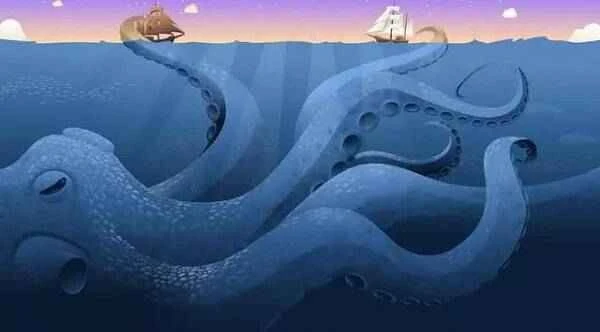
Animals that prey on giant squid include sleeper sharks and toothed whales, with sperm whales being the giant squid's primary predator. Giant squid are the sperm whale's main food source, and sperm whales frequently dive to depths of hundreds of meters to hunt them. Because this process occurs in the deep sea, it has never been witnessed by humans, and people can only speculate about how sperm whales hunt giant squid.
In April 1978, sucker imprints of a large cephalopod were found beneath the head of a male sperm whale that had stranded in the waters off Jiaonan, Shandong, China. The suckers, with diameters of 40 mm and 20 mm, were identified as imprints of a large sucker in the center of a giant squid's tentacle and two smaller suckers on either side. Most of the whale flesh in the center of the imprints had been sucked out, with only a small portion remaining attached, demonstrating the intensity of the struggle. Similar accounts have been found in special reports on other sea areas around the world.
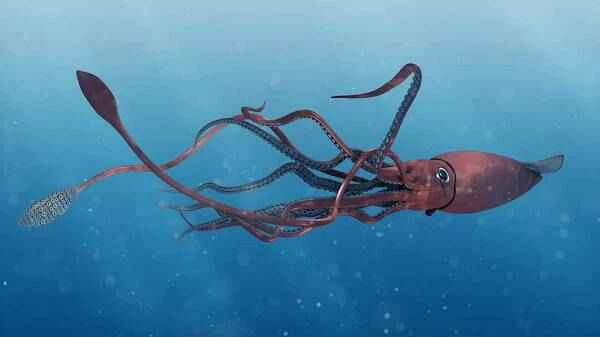
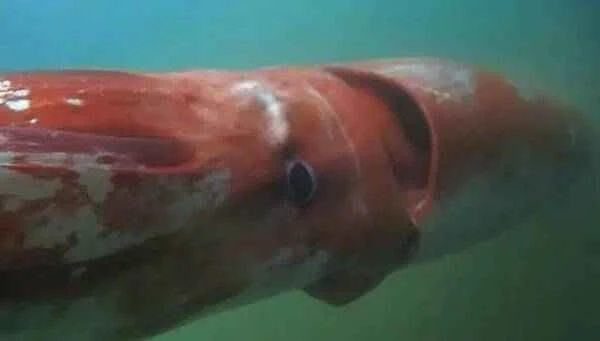
On February 21, 2019, residents of Shimofu-cho, Hamada City, Shimane Prefecture, Japan, discovered the carcass of a giant squid measuring 3.4 meters in length. According to the Asahi Shimbun, the first person to discover the squid was a local woman. She was driving home and initially mistook it for a fish, but upon closer inspection, realized it was a dead giant squid. Aquarium staff determined that the squid was female and contained eggs. It weighed 135 kilograms and was 3.4 meters long. Its two predatory tentacles were missing; had they remained, the squid would have been 6 to 7 meters long. This was the third giant squid discovered in the waters off Hamada City, Shimane Prefecture, since September 2014. An aquarium staff member stated that giant squid typically inhabit the deep Pacific Ocean at depths of 600 to 1000 meters, and its presence in the Hamada City area was likely due to being washed ashore by the Tsushima Current.
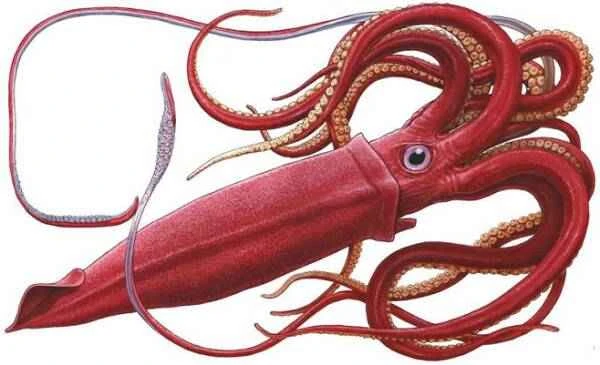
Experts believe that the largest reliable individual of the giant squid should be the adult female from Tasmania with a mantle length of 2.4 meters. Considering that the giant squid with a mantle length of 2.25-2.3 meters is close to 13 meters in total length, its total length may exceed 13.6 meters.