The snow leopard originated from the Qinghai-Tibet Plateau. Molecular biological studies show that among extant felines, the snow leopard is most closely related to the tiger, with the two diverging approximately 2 million years ago. Within its distribution range, the snow leopard inhabits high-altitude habitats, making it the feline with the highest altitude distribution globally. They prefer to move through steep terrain, including alpine scree slopes, ridges, and cliffs. Their relatively short, stout limbs and long, powerful tail allow the snow leopard to move freely among steep rocks.
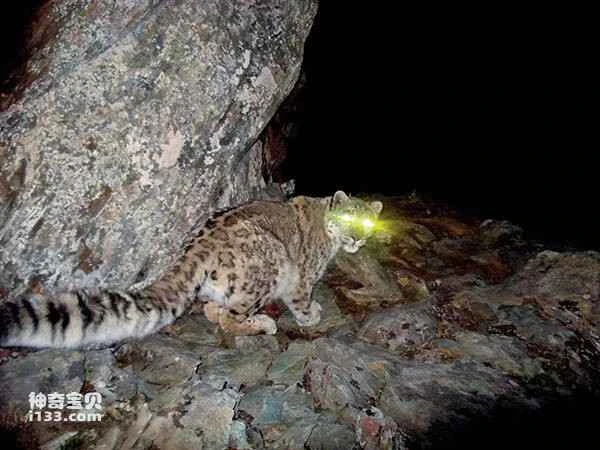
Recently, reporters learned from the Publicity Department of Jiuzhi County, Qinghai Province, that on February 14, two adult snow leopards were discovered in the Nianbaoyuze Protection Zone of the Sanjiangyuan National Nature Reserve in Jiuzhi County, Golog Tibetan Autonomous Prefecture. This is the first time that clear images of snow leopards have been recorded in the area.
It is reported that on February 12, the Nianbaoyuze Scenic Area Protection and Management Bureau received a report from a herdsman in Suohurima Township, Jiuzhi County, that one of his underage yaks had gone missing and could not be found, and there was a possibility that it had been hunted and killed by a snow leopard.
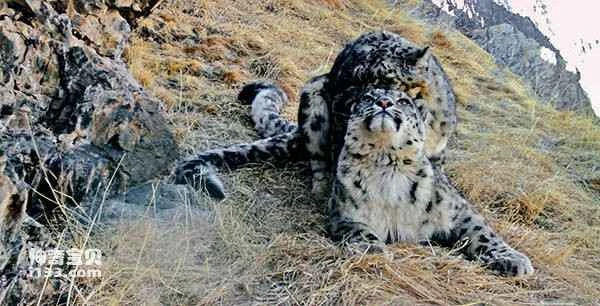
Upon learning of the situation, the Nianbaoyuze Scenic Area Management Bureau immediately dispatched personnel to the site. After three consecutive days of tracking footprints and staking out the location, they finally captured clear images of two adult snow leopards using a drone in a rocky area at an altitude of 4,500 meters within the territory of Suohurima Township.
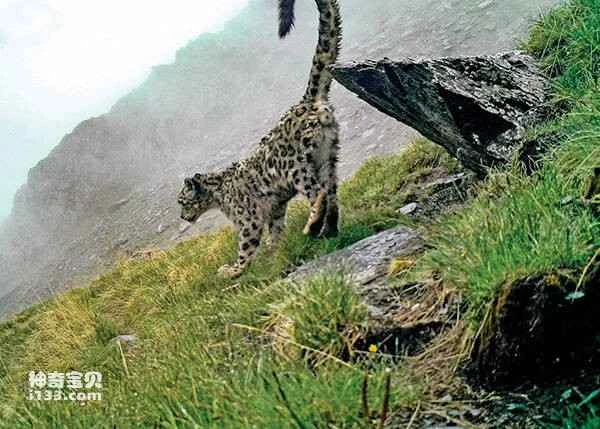
A snow leopard photographed by drone by staff of the Nianbaoyuze Scenic Area Management Bureau.
Snow leopards typically inhabit mountain ridges at altitudes of 2,500 to 5,000 meters, and are often referred to as a "barometer of the health of high-altitude ecosystems." They were listed as an endangered species in the 1996 China Red Data Book of Endangered Animals. Currently, China has become the country with the largest distribution of snow leopards globally, encompassing 60% of their habitat, and they are found in provinces and regions such as Qinghai, Sichuan, Xinjiang, and Tibet.
Jiuzhi County, located in the core area of the Three Rivers Source Region, is a county under the jurisdiction of Guoluo Tibetan Autonomous Prefecture in Qinghai Province, at the junction of Qinghai, Sichuan, and Gansu provinces. The average altitude here is over 4,000 meters. Within its borders, Nyainqêntanglha Mountain preserves geological relics such as glacial erosion landforms, glacial moraine landforms, and modern glaciers, and is known as the "Garden of the Gods".
In recent years, the Jiuzhi County Party Committee and County Government have continuously increased their efforts in protecting and publicizing the ecological environment and wildlife. As the local ecosystem gradually recovers and the food chain becomes more complete, the number of wild animals such as blue sheep, wild boar, serow, lynx, Przewalski's gazelle, and roe deer in the area has been increasing. Wild snow leopards have been spotted multiple times in the Nianbaoyuze Nature Reserve.