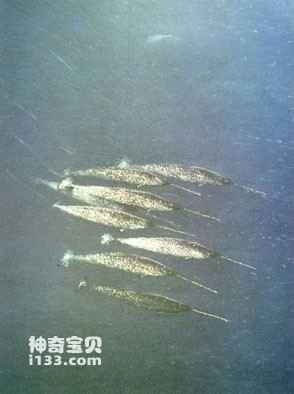
From a distance, narwhals appear to have a long horn on their heads, hence their name. The narwhal's "horn" is actually a giant tooth. During embryonic development, narwhals have a total of 16 teeth, but most of them degenerate and disappear by birth, leaving only two in the upper jaw. In females, the teeth remain hidden in the upper jaw throughout their lives, while in males, only the left tooth protrudes forward through the upper lip, reaching a length of 2-3 meters, somewhat resembling Don Quixote's lance; the right tooth is also concealed. However, in rare cases, both of their longer teeth may protrude forward simultaneously, resulting in a biphasic narwhal.
What is the purpose of a narwhal's tusk? Some scientists believe that narwhals use their tusks to dredge seabed sediment to help find food. Others believe that narwhals, living in the cold waters of the Arctic, can use their tusks to break through ice like seals to breathe. However, these explanations are difficult to reconcile. Still other biologists believe that the narwhal's long tusk is simply a secondary sexual symbol, much like how humans have thick, bushy beards. They also suggest that the tusk could be used as a defensive and offensive weapon, especially during the breeding season. Male narwhals engage in fierce battles using their tusks to compete for reproductive dominance. The longer the tusk and the stronger the physique, the greater the advantage, making it easier to defeat rivals and achieve hegemony, thus monopolizing the harem. But these are all just speculations.
Narwhals are relatively easy to catch because they like to stay on the surface of the water for extended periods. However, narwhal meat is not very palatable and does not suit the Inuit taste, so the Inuit did not pay much attention to them. Later, because Westerners mistakenly identified narwhals as the legendary unicorns and believed that their horns could cure all diseases, they became more valuable than gold, resulting in the rampant hunting of narwhals.