More than 70 years ago, in order to find fossils and cultural relics left by the earliest humans, the American Museum of Natural History organized a large "Central Asia Expedition" that went deep into Inner Mongolia, Gansu and Xinjiang in China and the Gobi Desert in Mongolia to conduct the largest paleontological expedition in history.
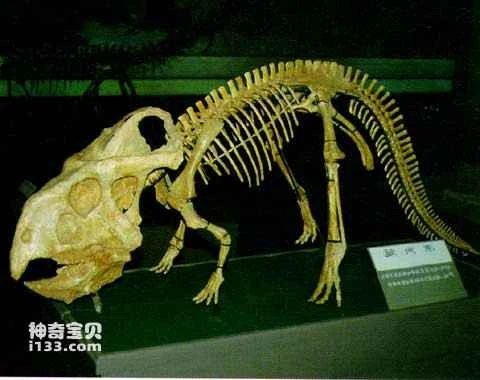
Protoceratops
Although this expedition did not find the fossils and cultural relics left by the earliest humans that we had high hopes for, it did discover countless other important vertebrate fossils, which greatly enriched our understanding of the history of ancient life.
Protoceratops is one of the "jewels" among these many precious discoveries.
Braving the scorching heat of the Mongolian Plateau, the expedition team unearthed a large number of complete Protoceratops skulls and skeletal fossils, providing us with a comprehensive understanding of these oldest ceratopsians. Protoceratops lived 90 million years ago, measuring less than 2 meters in length and weighing less than 200 kilograms; it also lacked the bizarre horns found in later ceratopsians. However, these "little guys" already exhibited a series of trends in skeletal features and body morphology consistent with later ceratopsians, confirming Protoceratops' ancestral status as the most primitive ceratopsian species. For example, they possessed a large, heavy skull with a broad bony fold extending from the back of the skull to the neck. This broad bony fold is called the nuchal frill. To reduce unnecessary weight, the nuchal frill had two window-like openings. Like other ceratopsians, Protoceratops had a narrow mouth, resembling a parrot's beak. However, unlike a parrot, Protoceratops had a strong jawbone with teeth.
Initially, the function of the neck frill in Protoceratops was unclear. Later, through careful anatomical analysis, scientists discovered that this bony fold primarily served to attach powerful muscle tissue connecting the back of the skull to the mandible. This muscle group, called the temporalis muscle, is responsible for driving the mandible to perform biting and chewing. Therefore, it can be inferred that Protoceratops, and later ceratopsians, possessed a much stronger chewing ability than other herbivorous dinosaurs, clearly an adaptation to the increased proportion of fibrous plants in their environment. Furthermore, the neck frill in Protoceratops could also serve as an attachment point for the powerful neck muscles that control head movement. Of course, the presence of the neck frill also protected the neck area from attacks by carnivorous dinosaurs, thus also functioning as a protective organ.
Protoceratops had not yet developed the various large horns found in later ceratopsians, but the rudiments of such horns—a small bony ridge called the nasal horn—had already grown along the upper edge of its snout. Some scientists believe that this ridge was only present in males and served as a fighting feature for mates.
Protoceratops is one of the most well-known dinosaur species, thanks to numerous fossilized eggs representing various stages of development from infancy to adulthood, including several nests of eggs, some still containing embryos. These eggs were similar in shape to lizard eggs, elongated oval, larger at one end and smaller at the other. The shells were calcareous, rough, and decorated with fine, zigzag striations. The arrangement of the fossilized eggs suggests that female Protoceratops laid their eggs in sand, arranging them in concentric circles, much like modern turtles. These eggs were clearly covered with sand and incubated by the sun's heat. For modern paleontologists, it's fortunate that some of these eggs, laid tens of millions of years ago, have not yet hatched; otherwise, how would we know about the remarkable behaviors of these mysterious animals from millions of years ago?