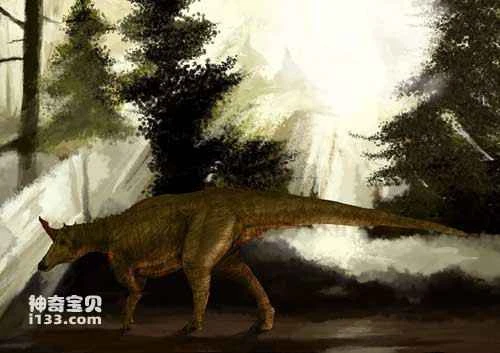
Members of the hadrosaur family are known for their gentleness, elegance, and handsomeness. If there's a "handsome man" among the hadrosaur family, the Qingdao Dragon, discovered in Shandong, my country, undoubtedly deserves the title. The Qingdao Dragon is the most famous hadrosaur fossil with a crest discovered in my country, and also the first complete dinosaur fossil found in the country. It was named after the crest it had on its head, which it discovered in Xigou, Jingangkou Village, Laiyang City, near Qingdao.
The Qingdao dragon fossil dates to the Late Cretaceous period. It was 6.62 meters long and 4.9 meters tall, with a broad, flat lower jaw resembling a duck's bill. It had numerous teeth, an enlarged, foot-like distal end to its ischium, and a prominent upper calcaneus. A distinct straight-ridged structure was present on the ventral side of the sacrum, forming a groove behind the structure. The crest on its mount was actually a ridged, rod-shaped spine on the posterior nasal bone, resembling a unicorn's horn, extending straight forward from between its eyes. It is estimated that it weighed 6-7 tons when alive, but its brain was very small, weighing only 200-300 grams.
The physical characteristics of Qingdao dragon are not much different from those of a "standard" hadrosaur, except for a long, thin horn on its head, making it look like a unicorn. Some say this horn should be tilted forward, others say backward, and still others say it doesn't exist at all. The function of this horn is even more debated; it's neither a weapon nor amplified like other crowned hadrosaurs. So, it's just an ornament. However, some have pointed out that this tube spine might be a displaced (or misplaced during restoration) nasal bone, mistakenly placed vertically at the front of the skull. If this is true, then Qingdao dragon might belong to a flat-headed hadrosaurid.
Chinese name: Qingdao Dragon
Latin name: Tsintaosaurus
Age of existence: Late Cretaceous
Fossil origin: Shandong, China
Physical characteristics: 6-7 meters in length
Diet: Plants
Species: Ornithopods
Definition: Lizard from Qingdao