In China's freshwater fish farming, the four well-known major freshwater fish species include black carp, grass carp, silver carp, and bighead carp. These fish all belong to the Cyprinidae family of the Cypriniformes order of the class Actinopterygii. They have long been the mainstay of my country's freshwater aquaculture industry and are therefore known as the "Four Major Freshwater Fish." The farming volume of these four fish accounts for approximately 48% of China's total fish farming output.
Before the Tang Dynasty, carp was the most widely farmed freshwater fish. However, because the Tang emperors were surnamed Li, the authorities explicitly prohibited the farming, fishing, and sale of carp, forcing fishermen to find new aquaculture species. As a result, grass carp, silver carp, and bighead carp gradually emerged. Due to their unique feeding and habitat habits, these four fish can effectively utilize natural food and water resources when polycultured in the same pond, thus achieving better aquaculture benefits. Therefore, they have become indispensable and important fish species in my country's traditional aquaculture industry.
1. Grass carp
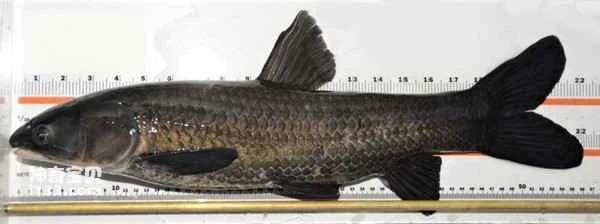
As one of the four traditional freshwater farmed fish in China, the black carp belongs to the order Cypriniformes, family Cyprinidae, subfamily Leuciscinae, and its scientific name is *Spatholobus*. Black carp has many common names, such as 青鲩 (qīng huā), 乌青 (wū qīng), 螺蛳青 (luó qīng), 黑鲩 (hēi huā), 乌鲩 (wū huā), 黑ө (hēi dǎng), 乌ө (wū dǎng), 铜青 (tóng qīng), 青棒 (qīng bàng), and 五侯青 (wǔ hóu qīng). It has a long and slender body, reaching about 150 cm in length. Its body is slightly cylindrical, with a smooth belly and a slightly flattened tail, lacking a ventral keel. The head is slightly flattened, with a blunt snout, slightly sharper than that of the grass carp. The mouth faces upwards in an arc shape. The back and upper sides are dark green or black, while the belly is grayish-white. Black carp typically inhabit the middle and lower layers of the water, behaving slowly and steadily. Their main diet consists of snails, clams, mussels, and other small fish, occasionally also nibbling on shrimp and insect larvae. Black carp grow quickly and reach a relatively large size, with the largest adults exceeding 100 kilograms, such as the one caught on September 19, 2004, in Jinniu Lake, Nanjing, Jiangsu Province. Black carp are a high-value fish, and due to their ease of rearing, they have been introduced to the southern United States for aquaculture in recent years.
2. Grass carp
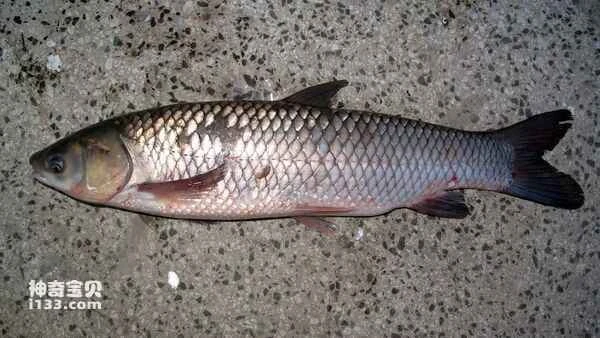
Grass carp, also known as hu, oil grass carp, grass carp, white grass carp, and grass root (Northeastern dialect), belongs to the Cyprinidae family, Cypriniformes order, and Actinopterygii class. It is a crucial fish species in China's freshwater aquaculture industry, and along with silver carp, bighead carp, and black carp, is considered one of China's "Four Major Domesticated Fish." Grass carp have a cylindrical body, a slightly flattened head, and a slightly flattened tail. Their mouth is arched and lacks barbels; the upper jaw is slightly longer than the lower jaw. The body is pale yellowish-brown, the back is bluish-gray, the belly is grayish-white, the pectoral and pelvic fins are slightly grayish-yellow, and the other fins are light gray. Grass carp are active, agile swimmers, and often forage in groups, making them typical herbivorous fish. Grass carp meat is tender, boneless, and rich in nutrients; its scales and skin can be used to make glue, making it suitable for various cooking methods. Especially prized in Cantonese cuisine are grass carp raised on broad beans, known for their tender texture, firm flesh, and resistance to becoming mushy even after prolonged cooking. There is a common misconception that grass carp bile has the effect of "clearing the liver and improving eyesight," but in fact, grass carp bile is poisonous and can easily lead to acute liver and kidney failure if consumed. It is especially unsuitable to eat raw.
3. Silver carp
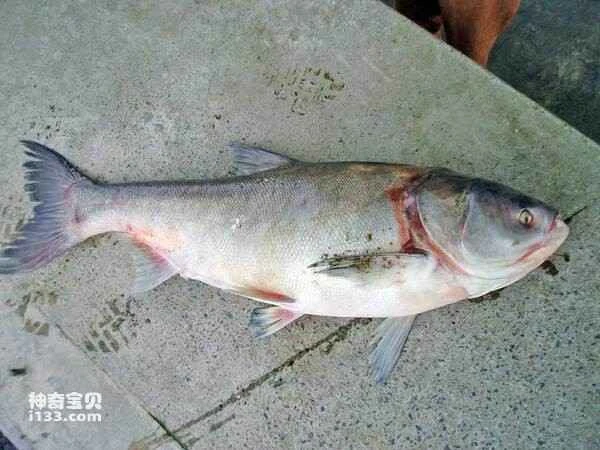
Silver carp, also known as silver carp, water carp, or jumping carp, belongs to the genus *Carex*, family Cyprinidae, and order Cypriniformes. It is one of China's major freshwater aquaculture fish, and along with grass carp, black carp, and bighead carp, is considered one of the "Four Major Domesticated Fish of China." Silver carp typically have a silvery-white body, grayish-white fins, and a relatively small head, about one-quarter of its body length. Its pectoral fins spread outwards, with the tips extending only to the base of the pelvic fins. A distinct sharp ridge runs along the abdomen from in front of the pelvic fins to the entire abdomen. Its body is slightly flattened and high, with an oval shape. The back is bluish-gray, while the sides and belly are white. Silver carp are a large freshwater fish commonly farmed artificially. They grow quickly, are less prone to disease, and have high yields. They are often polycultured with grass carp and common carp. Their flesh is tender and nutritious, making them a high-quality fish suitable for aquaculture. In Taiwan, silver carp is an important freshwater aquaculture fish.
4. Bighead carp
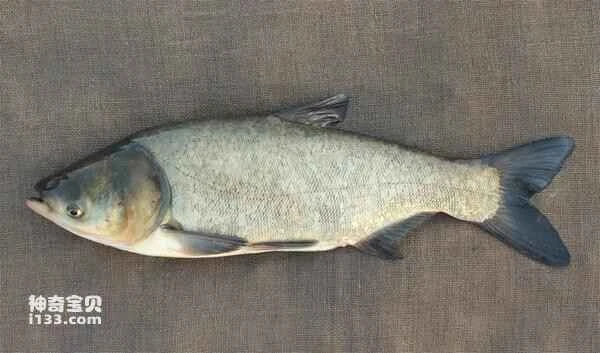
Silver carp, also known as bighead carp, is a freshwater fish species, hailed as the "water cleaner fish." It is unique to China and is one of the four major freshwater fish species in the country. Silver carp have a wide distribution in China, mainly inhabiting the middle and upper water layers of rivers, moist river bends, lakes, and reservoirs. They are a primary target for pond aquaculture and reservoir fishing. They not only have high economic value but also significant nutritional value, playing a significant role in improving intelligence, enhancing memory, and providing nutritional supplementation. Silver carp are migratory and typically live in fast-flowing water environments. They grow rapidly, reaching a maximum weight of 40 kg.