Sharks are a general term for animals in the superorder Squaliformes, which have evolved into approximately 500 different species. The smallest shark is the dwarf shark, which is only about 17 centimeters long, while the largest shark is the whale shark, which can exceed 12 meters or even longer. Sharks are generally known to be "beautiful" deep-sea tyrants; however, different species of sharks look very different, and some bizarre-looking sharks are quite distinctive.
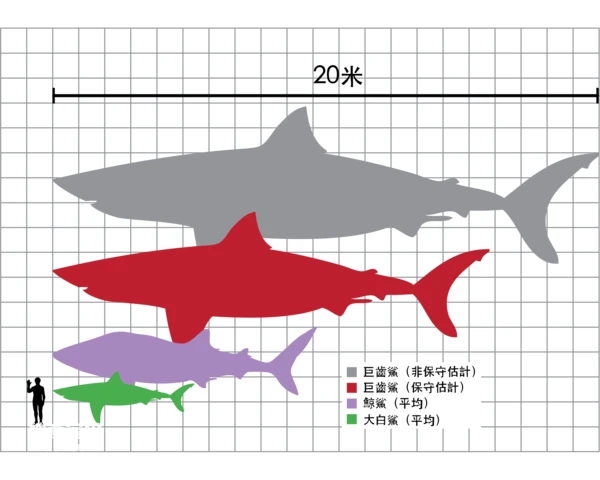
Size comparison between Megalodon , whale shark , great white shark , and human.
The world is home to many strangely shaped shark species, including notable ones such as the goblin shark, spiny shark, hammerhead shark, frilled shark, foxtail thresher shark, sawshark, and miracadabra. These sharks exhibit unique physical characteristics, such as bizarre shapes and peculiar appearances, leaving a lasting impression. Let's learn about these extraordinary sharks and explore their unique appearances and ecological features.
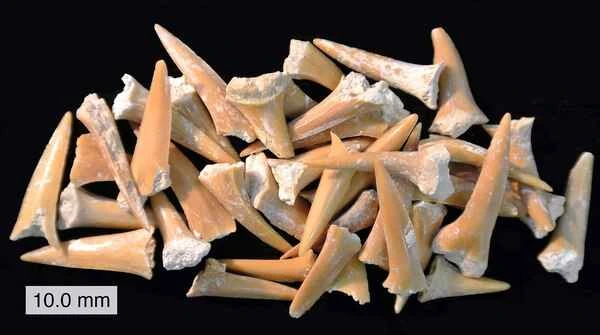
Shark teeth fossils from the Cretaceous period
1. Goblin Shark (pink body, looks like a goblin)
Goblin sharks, also known as Eugène's sharp-nosed sharks or devil sharks, are one of the ten most unusual sharks in the ocean and are often listed in rankings of shark wonders.
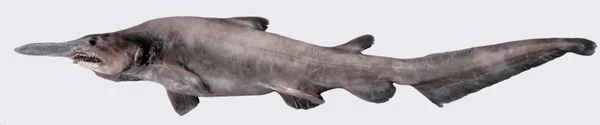
The Eurasian snapping shark, a species that has existed for 125 million years, with the earliest record dating back to 1898, has been distributed in temperate and tropical waters around the world , from Australia in the Pacific Ocean to the Gulf of Mexico in the Atlantic Ocean . They were first discovered in waters off Japan. They primarily inhabit deep-sea areas where sunlight cannot reach, typically living in waters up to 200 meters deep.
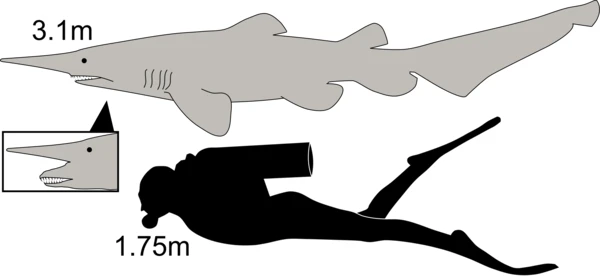
These sharks have pink bodies, which is extremely rare in the shark world. This is due to the translucent nature of their skin, which makes their blood vessels visible, giving them a pink visual effect. While most sharks may have a relatively prominent snout, few have a snout as long as the Goblin Shark, especially its sword-like long snout, which can reach half a meter in length among sharks that are 3 meters long. Even more peculiar is the Goblin Shark's retractable long snout; its ugly appearance resembles a goblin from European mythology, hence its nickname "goblin shark," adding to its unique and mysterious charm.
2. Spinosaurus (dorsal fin shaped like an anvil)
The spiny-backed shark, also known as the toothed shark, lived from the Late Devonian to the Early Carboniferous period, approximately 36 million years ago. Its fossils have been found in Asia , Europe , and North America . The closest extant relative of the spiny-backed shark is the chimaera .
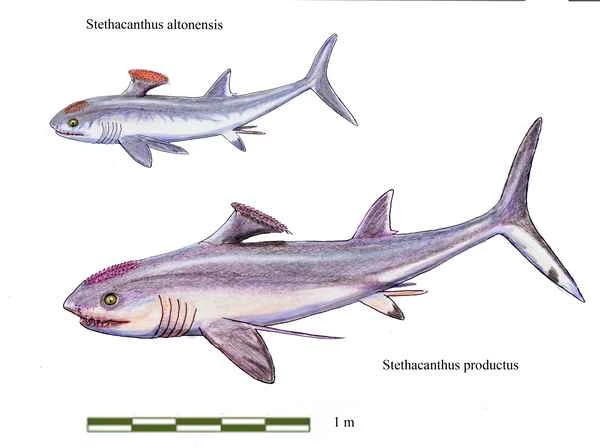
The spiny shark is one of the world's most unusual sharks. Reaching approximately 70 centimeters in length, it resembles modern sharks in appearance. Its most striking feature is its unique dorsal fin, shaped like an anvil, which stands upright on its back.
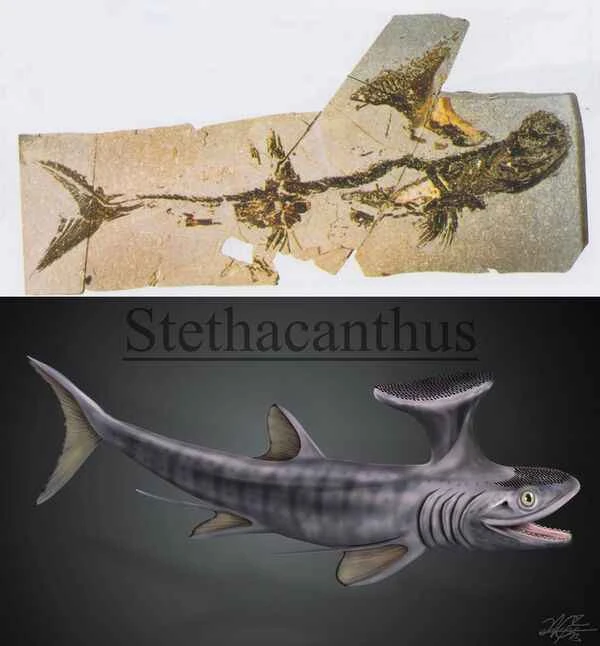
These dorsal fins are covered with rough, serrated scales, giving them a bizarre appearance. Interestingly, these unusual dorsal fins have only been observed in male spiny sharks, leading some researchers to speculate that they may have been used for courtship or self-defense.
3. Hammerhead shark (its head resembles a hammer)
Hammerhead sharks are another type of bizarre-looking shark, typically around 1 meter in length, though larger specimens can reach over 3 meters and weigh over 150 kilograms. Their heads have an unusually peculiar shape, believed to function as a kind of rudder to enhance their maneuverability; their two nostrils are also widely separated, a feature that makes them more adept at identifying scents.
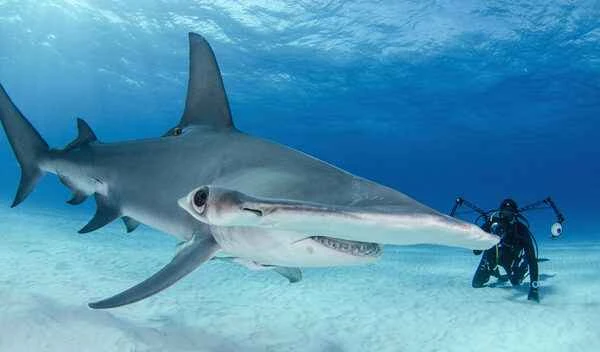
Research suggests that hammerhead sharks evolved their distinctive hammer-shaped heads approximately 50 million years ago. However, scientists have offered various speculations about this unique head shape, such as the unanswered question of its benefits to hammerhead sharks. The hammer-shaped structure of the hammerhead shark's head may have increased the distance between its olfactory sensors, potentially helping it to more accurately capture prey further away.
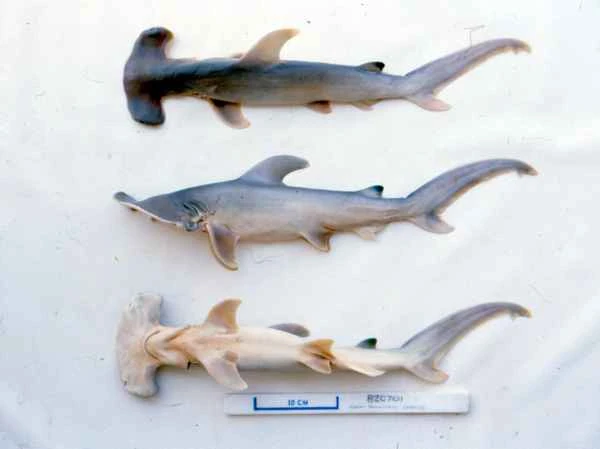
Hammerhead shark embryos are connected to their mothers via the placenta during pregnancy.
4. Frilled shark (looks like an eel)
The frilled shark, also known as the frilly shark, is listed as one of the ten strangest sharks. This shark possesses a primitive body structure and is hailed as a "living fossil." Its appearance is more similar to an eel than most modern sharks. The frilled shark is famous for its unique tooth arrangement. This shark has approximately 300 triangular teeth arranged in 27 rows, filling its entire oral cavity.
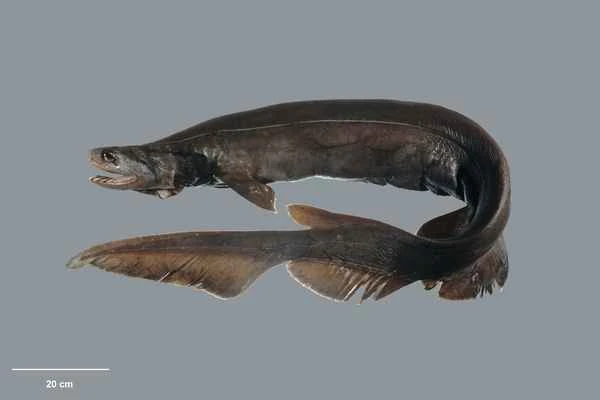
In addition, they have six gill slits on each side of their bodies, and these gill slits are elongated and folded, overlapping each other. Frilled sharks are very ferocious when hunting, but they will not attack humans.
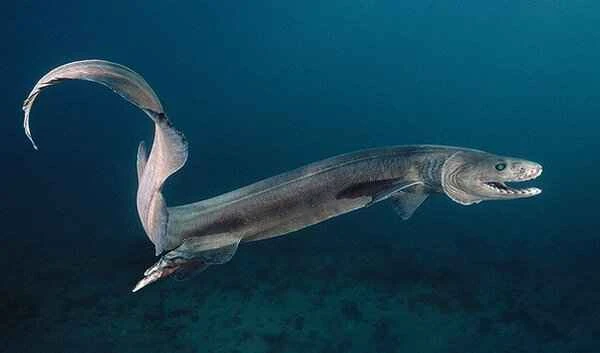
Frilled sharks are very rare, and are mainly found in scattered areas of the Atlantic and Pacific Oceans.
5. Fox-shaped Thresher Shark (with an extra-long tail)
The thresher shark is considered one of the world's most unusual sharks, with its tail sometimes accounting for half its body length. Especially for species like the foxtail thresher, which can easily exceed six meters in length, its tail is at least three meters long. The slender thresher, on the other hand, is known for its slender body shape, featuring a cylindrical form that is wider at the front and narrower at the back, with a deep blue-green back that appears as if coated with blue-green ink.
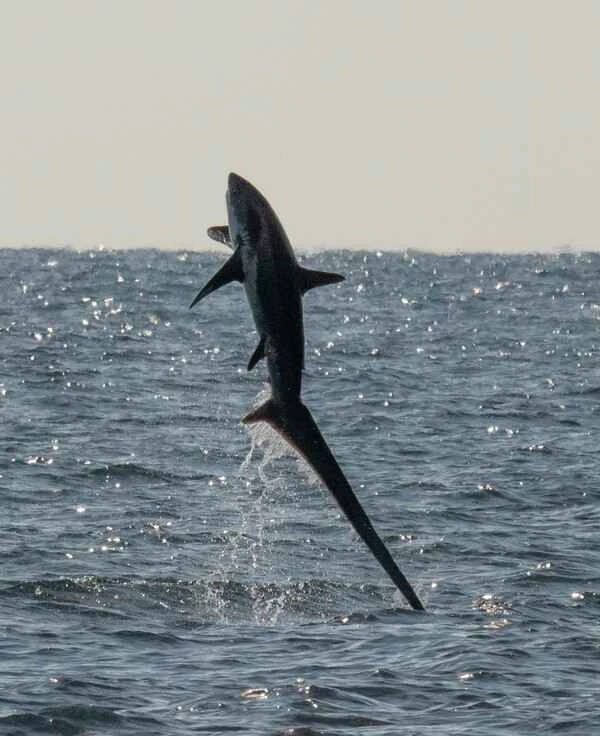
While its body coloration isn't particularly conspicuous, it provides excellent camouflage when hunting from a distance. Thresher sharks use their distinctive long tail to stun prey, and sometimes this can even be used as a defensive strategy.
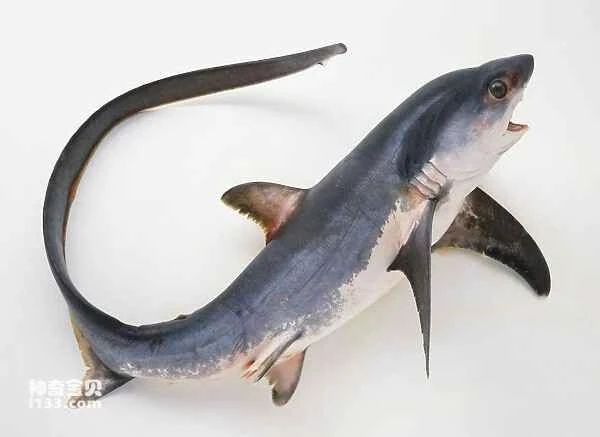
This fish is distributed in tropical waters of all the world's oceans. It can be found at depths of 0 to 550 meters.
6. Sawshark (its mouth resembles a saw)
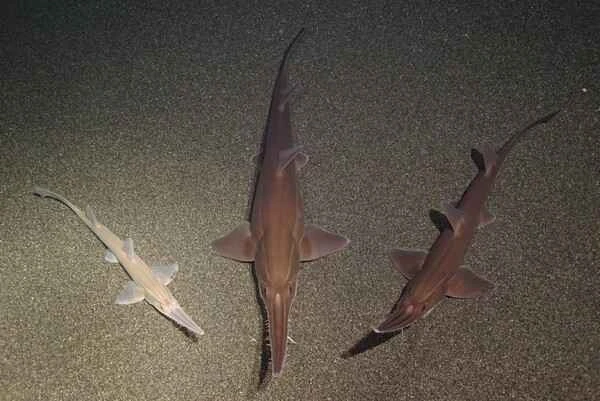
The sawshark is one of the most peculiar sharks in the deep sea, named for its built-in "saw." This ferocious shark lives on the bottom of nearshore waters and uses its long, serrated jaws to hunt prey. Although it resembles a sawshark in appearance, it actually belongs to the shark family. Like most sharks, the sawshark's gills are located on the sides of its neck, while the sawshark's gills are located on its underside. Despite these differences, sawsharks and sawsharks share a strikingly similar lifestyle: when marine life approaches, the sawshark uses its serrated jaws to suck in the remains of its prey, already shredded by its "saw."
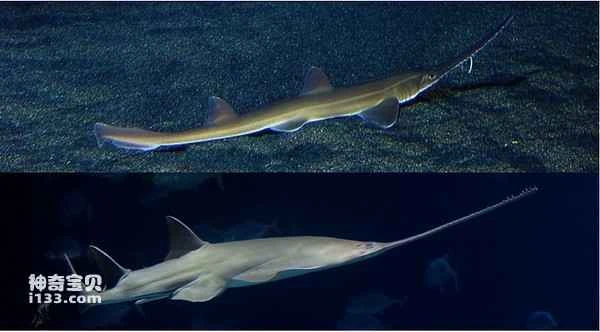
Sawsharks generally live at depths of 40 meters, feeding on benthic organisms and fish. They are distributed in a wide range of waters from South Africa to Japan . Sawshark meat is edible, and the Japanese especially enjoy eating it.
7. Miracan Eagle Finless Shark (a winged shark)
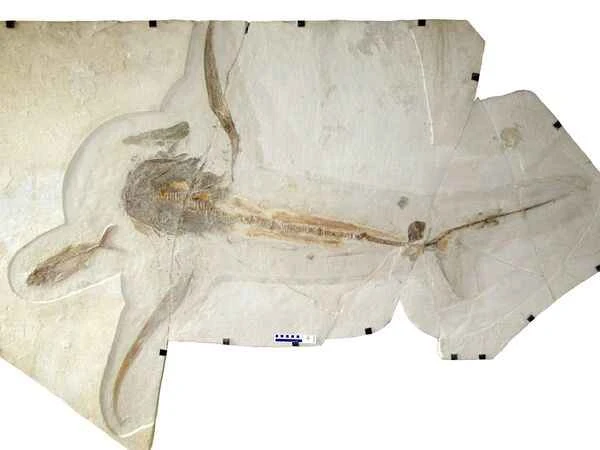
Of all extinct sharks, I believe the Miracan eagle-rat shark has the most unique appearance. Like all sharks and their ray relatives, the Miracan eagle-rat shark possessed a cartilaginous structure. Its body was streamlined, with traditional shark fins and a tail, but its pectoral fins were distinctive. The Miracan eagle-rat shark's slender pectoral fins resembled the wings of a glider or a flying creature, setting it apart from the rest.
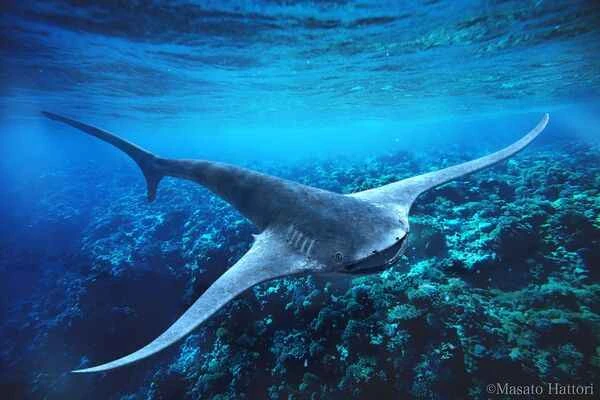
The holotype of the Miraca eagle-rat shark is only 1.66 meters long, but its pectoral fins, when fully extended, can reach 1.9 meters in width. These exaggerated pectoral fins may have had a balancing effect similar to aircraft wings, resembling a pair of real wings.
8. Helicoprion (teeth curled inward into a spiral shape)
Helicoprion, scientifically known as *Helicodon*, is another bizarrely-looking shark. Its name, *Helico*, comes from the Greek word for "spiral," and *Prion* from "saw," thus meaning "spiral saw." This name derives from its unique tooth structure. The Helicoprion's teeth are arranged in a spiral, from large to small, resembling an inward-curving ring, much like a milling cutter, giving them a strong cutting feel and inspiring awe. However, the exact location of these teeth remains controversial and has been a subject of much attention since their initial discovery.
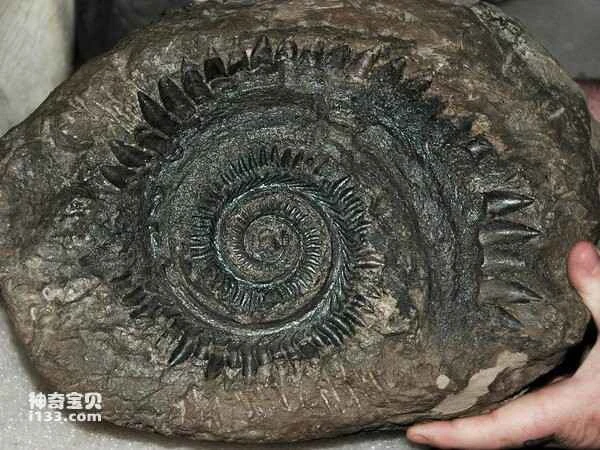
Helicoprion was first discovered in 1899 by Russian paleontologist Alexander Karpinsky in the Ural Mountains.
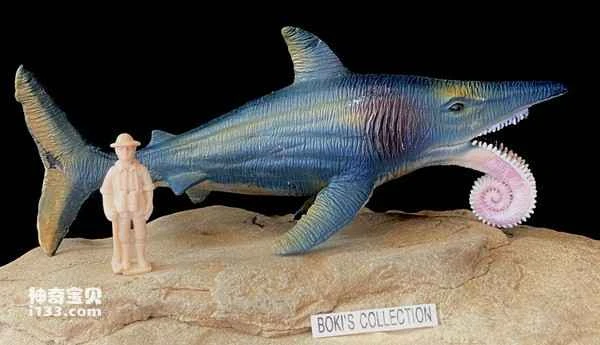
Since the discovery of the Helicoprion, the exact location of its teeth within the shark's mouth has been a subject of ongoing debate. This is because no other anatomical structure resembling a ring of spiral teeth has been found in any extant shark or other vertebrate.
9. Sharpback dogfish (shark body, pig face)
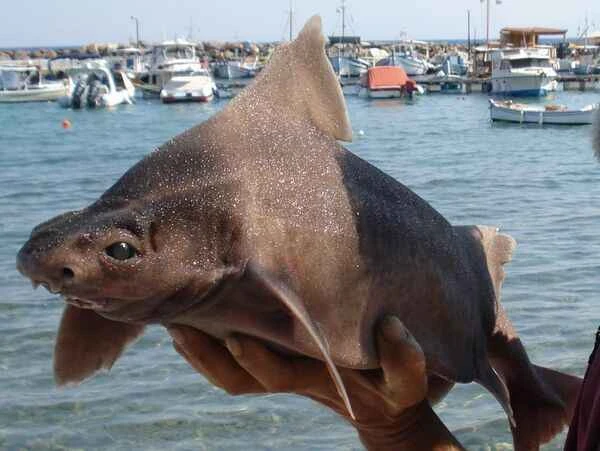
The sharp-backed dogfish (Oxynotus centrina) typically inhabits waters at depths of about 700 meters, with a range spanning the eastern Atlantic and Mediterranean. This shark, known for its broad, flat head and plump, blunt snout, is a highly regarded species. Listed on the International Union for Conservation of Nature (IUCN) Red List of Threatened Species, it is extremely rare, and its presence caused a stir on social media in 2021.
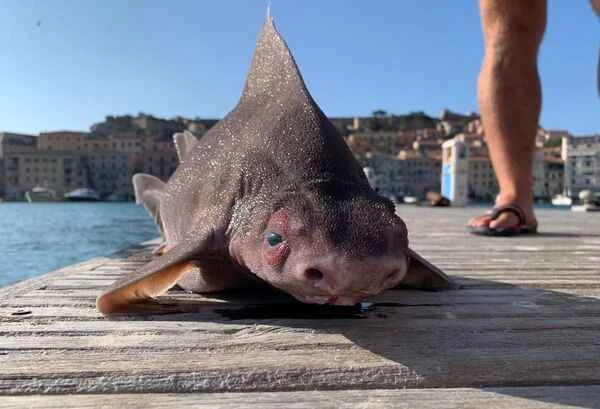
This peculiar creature, which looks like a shark, has a face that resembles a pig more, hence its nickname "pig-faced shark." For years, sharpbacked dogfish have frequently been caught in fishing nets, leading to a sharp decline in their population.
10. Prawn shark (a slow-moving small shark)
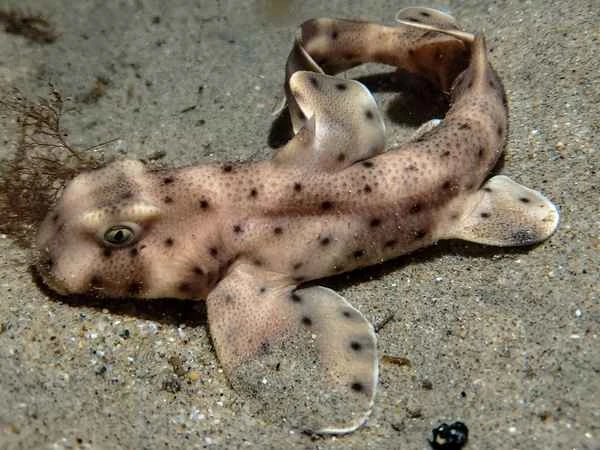
Carlos's tiger shark, also known as the dogfish, is a quiet and unassuming small shark. Its dorsal fin is dark to light gray or brown, and its body and fins are covered with dark brown or black spots, generally less than one-third the diameter of its eye; smaller spots are mainly clustered on the head and tail. Carlos's tiger sharks are known for their slow swimming, are nocturnal, and prefer to live alone. They typically inhabit sandy shallows, reef caves, and seaweed beds, and adults almost daily return to their original habitats. They are carnivorous, primarily feeding on various marine invertebrates.
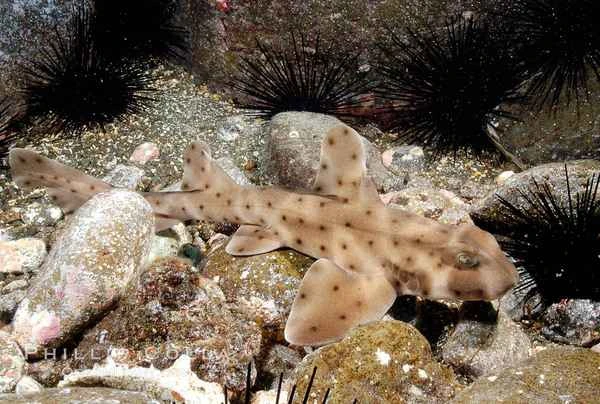
This fish is found only in the waters between California , USA , and the Gulf of California, Mexico . The volcano shark is harmless to humans and adapts very well to captive environments. Currently, there is very little fishing activity targeting this fish, and its population faces minimal threat.
Shark trivia:
Because some people in certain regions enjoy eating sharks, especially shark fins , it's estimated that 100 million sharks are killed by humans every year. The consumption of shark fin soup by humans is a major factor contributing to the decline in shark populations.

Most sharks are portrayed negatively in movies, depicted as terrifying man-eating monsters. In reality, out of hundreds of shark species, only a few have a proven history of threatening humans and eating people. Of all sharks, the great white shark, the tigress shark , and the bull shark are considered the most dangerous. However, not all sharks are ferocious; whale sharks, for example, are quite docile filter feeders. They pose absolutely no threat to humans; divers can swim alongside them and even touch their bodies.
Sharks have highly sensitive sensory organs, capable of detecting the smell of blood from kilometers away. They also have the ability to sense electrical currents, which they can use to detect the faint bioelectricity emitted by the muscles or heart of their prey hidden under the sand.
Sharks do not attack indiscriminately and have no interest in human blood, but it is still advisable to avoid swimming in areas where sharks are present. For example, surfboards that resemble seals may tempt sharks to prey on them.

Shark movies
Jaws: A 1975 American thriller film
Jaws 2
Shark Gang
Finding Nemo
Octopus Shark
Deep in water and scorching hot
Soul Surfer
Shark Island
Megalodon
Shark Beach