The swordfish (genus Toxotes ) is one of the world's most fascinating and unique fish, renowned for its astonishing ability to precisely jet streams of water. This extraordinary skill not only sets the swordfish apart from other aquatic animals but also demonstrates how nature helps animals adapt to their environment. This article will delve into the swordfish's abilities, behavior, and why it is known as the "sharpshooter of the fish."
What is a bowfish ( swordfish) ?
1. History of Zoology
▪Scientific and genus information
Swordfish, also known as bowfish, belong to the family Toxotidae , scientifically named Toxotes . This family belongs to the class Perciformes and is a part of bony fishes . The Toxotidae family includes several different types of bowfish, which are known for their unique water-shooting ability, accurately shooting water at prey on the water's surface.
▪ Evolutionary History of Species
The evolutionary history of bowfish ( swordfish) dates back millions of years. Their water-shooting skills evolved to catch insects and small animals living above the water's surface. This specialized hunting method helps them find new food sources within their ecosystem, thus avoiding competition with other species.
▪ History of Species Discovery
Scientific descriptions of the bowfish ( swordfish) can be traced back to the early 19th century. European naturalists were the first to observe the bowfish 's water-shooting behavior, which greatly interested them. With further research, the bowfish became a subject of scientific study on animal behavior and adaptation.
▪ Reason for the name
The scientific name of the bowfish ( swordfish) , *Toxotes *, comes from the Greek word "toxotēs," meaning "archer." This name vividly describes the bowfish's ability to shoot water at its prey, much like an archer firing an arrow. Therefore, the name "bowfish" is a praise for its precise water-shooting behavior.
2. Morphological characteristics
Bowfish are medium-sized fish, typically 10 to 30 centimeters (4 to 12 inches) in length. They have streamlined bodies that allow for rapid swimming. The most distinctive feature of the bowfish is its tubular mouth, specifically designed for shooting water. Their large eyes, located on the top of their heads, help them aim at prey on the surface of the water.
The bowfish ( swordfish) has a dorsal fin located at the rear of its body and a well-developed tail fin, which facilitates propulsion. Bowfish are typically silver in color with a horizontal black stripe running across their body, helping them camouflage themselves in their natural environment.
3. Differences between closely related species
The bowfish ( swordfish) can be distinguished from other bowfish species by its unique water-shooting behavior. While other bowfish species may also have similar mouth structures, the bowfish is the only species capable of accurately capturing prey on the water's surface using water-shooting.
In addition, the mouth structure of the bowfish ( swordfish) is different from that of other species, as other fish cannot form a tubular mouth specifically for shooting water like the bowfish ( swordfish) .
4. Lifestyle Habits
▪Personality traits
Bowfish are generally considered intelligent and adaptable. They are known for their ability to learn and improve their arching techniques through experience. Bowfish are somewhat social; while they don't always hunt cooperatively in groups, they occasionally move in small groups. They are curious about their environment and frequently explore the world around them.
▪ Activity Retreat
Bowfish are not known for long- distance migrations, but within their habitats, they do move according to seasonal changes. They typically inhabit shallower waters, especially where there is abundant prey at the surface. They also move between freshwater and saltwater environments depending on changes in water quality and food availability.
Predation behavior
Bowfish are carnivorous fish that primarily prey on insects, spiders, and other small animals above the water's surface. They use a unique water-shooting behavior to knock their prey underwater before catching them. Bowfish can adjust the angle and force of their water-shooting to accurately hit small prey.
▪Attack behavior
Bowfish typically do not attack other fish, but if threatened, they will adopt defensive behaviors, using water jets to frighten or confuse enemies, thus gaining a chance to escape.
5. Distribution range
Bowfish ( swordfish) are mainly distributed in Southeast Asia , northern Australia , and surrounding islands. They inhabit both saltwater and freshwater environments, including rivers, lakes, mangrove swamps, and coastal areas. They prefer shallow waters, especially those with abundant vegetation and insects on the surface. Bowfish have a wide distribution, including in Thailand, Malaysia, Indonesia, northern India, and northern Australia.
6. Reproduction methods
▪ Reproductive time
Bowfish typically breed during the warmer months when water temperatures are higher and food supplies are plentiful. The breeding season can vary depending on local climate conditions and water temperature variations.
▪ Reproductive methods and details
Bowfish are oviparous fish, and males attract females during the breeding season through territorial behavior. After successful mating, the female lays her eggs in a secluded location, usually among underwater plants or in rock crevices. The male guards the eggs until they hatch.
▪ Lifespan
Bowfish typically live 5 to 10 years in the wild, depending on environmental factors, food availability , and predator threats. In captivity , with good care and suitable conditions, bowfish can sometimes live even longer.
7. Preserve the status quo
▪ Protection Level
Currently, the bowfish is not listed as an endangered species, and there are no specific laws protecting it. However, its habitat is facing several threats, including habitat destruction, pollution, and the impacts of human activities.
▪ Population Status
The population of bowfish ( swordfish) in the wild is generally stable, but its numbers have declined in some areas due to habitat destruction. Their habitat is threatened by the reduction of mangroves and swamps.
▪Main Threats
The main threats to the bowfish ( swordfish) include pollution, habitat loss, and climate change. Industrialization, agricultural expansion, and urbanization have led to habitat destruction. In addition, overfishing is also a potential threat to bowfish populations.
▪ Protective measures
Currently, there are no specific conservation measures for the bowfin ( swordfish) , but protecting its habitat and strengthening ecological protection have indirectly helped the species' survival. Protecting natural habitats such as mangroves, rivers, and wetlands is crucial for the survival of the bowfin ( swordfish) .
8. Main Value
▪ Economic value
While bowfish ( swordfish ) are not directly an economic resource, they can promote ecotourism, especially in nature-themed tourist areas. By controlling insect populations, bowfish indirectly contribute to the balance of the agricultural environment, thus benefiting humans.
Nutritional value
Bowfish are not commonly caught as food, although they are edible. Due to their small size and the difficulty of catching them , they are rarely used as food.
▪ Research value
The archerfish 's water-shooting behavior and high learning ability make it valuable in scientific research. Researchers have obtained a wealth of valuable data on animal behavior, precise aiming, and animal cognition by studying its predation behavior and learning abilities. These studies are also frequently used in behavioral and learning studies.
Bowfish are among the most unique species in nature, demonstrating the wisdom of the natural world by capturing prey with their astonishing water-shooting ability. Although they are not currently endangered, habitat protection is crucial for ensuring the long-term survival of their populations. From a scientific perspective, bowfish provide invaluable insights into animal learning, behavior , and adaptation, continuing to attract the attention of scientists.
What makes the bowfish ( swordfish) so different?
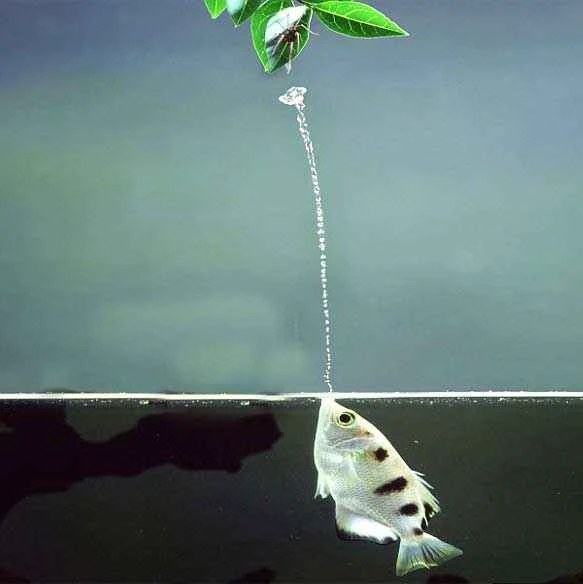
The most famous characteristic of the bowfish ( swordfish) is its ability to jettison water . These fish can shoot a stream of water from their mouths to strike prey (usually insects) on the surface of the water. The water jet can travel several feet and is exceptionally accurate, hitting its target precisely. Bowfish can even adjust the strength and direction of the water jet , aiming at their target like a seasoned sharpshooter.
How do bowfish ( swordfish) jet the water?
The archerfish's jet -jetting action is a marvel of natural evolution. Its working principle is as follows:
Mouth shape : The bowfish 's mouth is tubular, which allows them to jet out concentrated streams of water. The fish draws in water through a small opening formed between its tongue and the top of its mouth.
Water pressure : When a bowfish is about to launch, it contracts the muscles around its mouth , creating pressure inside its mouth that forces water to be ejected with great force.
Launching Mechanism : Bowfish ( swordfish) can control the intensity of the water flow and aim at their targets by adjusting the angle and force of the flow. This method allows them to accurately strike their prey, typically insects on the water's surface.
Prey targeting : The swordfish primarily uses this skill to catch insects or other small prey on the water's surface. By jetting water, the swordfish propels its prey into the water for easier capture.
Why do bowfish ( swordfish) spray water?
The primary purpose of bowfish ( swordfish) jetting water is for hunting . Their diet mainly consists of insects, spiders, and small invertebrates that live on the water's surface. Bowfish have evolved this skill to help them capture prey that would otherwise be difficult to reach.
Besides hunting, bowfish may also use jets of water as a defense mechanism . By creating disturbances in the water flow, they may scare away predators or competitors, gaining an opportunity to escape or fight back.
How far can a bowfish ( swordfish) jet the water?
The distance that bowfish can jets of water is astonishing. Some species can jet their water up to 10 feet (about 3 meters) , although the exact range varies from species to species and individual. The accuracy of their jets is also remarkable; bowfish can accurately hit small targets such as insects hanging on the water's surface.
Can the bowfish ( swordfish) shoot jets of water to hit underwater targets?
While bowfish ( swordfish) exhibit remarkable accuracy in striking prey above the water's surface, they cannot jet streams of water underwater. Their mouth structure and launching mechanism are specifically designed for shooting at surface targets, and they rely on vision for aiming. Underwater targets are unsuitable for bowfish ( swordfish) .
The visual ability of the bowfish ( swordfish) to jet stream water.
Bowfish rely heavily on their vision , using their keen eyesight to locate and precisely target prey. Their highly developed eyes allow them to clearly see insects and small prey on the water's surface. By adjusting angle and distance, bowfish use their vision to determine the direction of water currents, ensuring accurate strikes.
Interestingly, researchers discovered that bowfish ( swordfish) can learn and improve their shooting skills through trial and error . In a laboratory setting, bowfish demonstrated how to adjust the force and direction of their jets based on new targets. This indicates that the bowfish 's water-jetting ability is not merely an instinctive reaction, but can be continuously improved through learning and experience.
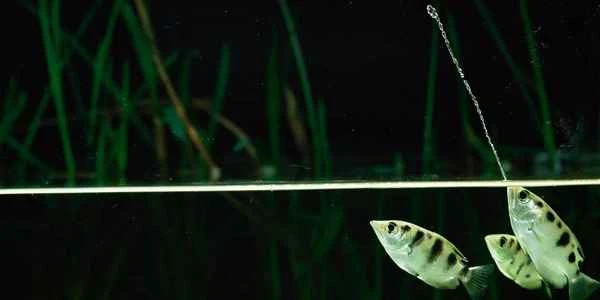
Bowgunfish Predation Behavior: The Role of Posture and Morphology in Aiming Behavior
Bowgunfish (Toxotidae) capture aerial prey by jetting water from their mouths. However, how they aim remains unclear. Previous studies, measuring the angle between the jet and the fish's body axis (mouth angle), have shown that body orientation plays a significant role in aiming, and some have suggested that more precise aiming might be related to lip and tongue movements. However, in our previous research, we found that the mouth angle is an individual characteristic with a much smaller range of variation than previously reported. Furthermore, we found that bowgunfish lack movable lips, and their tongues appear too short to guide the water flow. In our current study, we found that the tongue cannot even reach the front of the mouth, a crucial factor influencing water flow direction. Moreover, the mouth angle, as an individual characteristic, remains constant even at different target distances. These findings suggest that the only way to aim at the water flow is by adjusting the body angle. We also found that during aiming, the bowgunfish's body rotates around its eye, which is fixed in position, and the eye angle during aiming is also an individual characteristic, but the variation in eye angle is greater than that in mouth angle. This systematic variation may be related to the refraction of light.
Research Background
Bowgunfish, primarily terrestrial arthropods, capture prey by jetting water from their mouths. Lü Ling (1955, 1957) proposed that bowgunfish can accurately hit their targets despite water surface refraction because they either jet the water nearly vertically or correct missed shots by adjusting their aim. However, this view does not apply to their closely related species, *Toxotes chatareus*, which can successfully jet water over a wider range of angles. Our earlier research also indicated that the jetting angle of bowgunfish varies among individuals, with some individuals jetting excessively beyond their target, possibly related to abnormal growth of the lower jaw.
This study aims to clarify how bowfish aim at their targets. The study found that bowfish tend to choose different spray positions depending on the target's height: when the target is high, they choose a position away from the vertical line, and when the target is low, they choose a position closer to the vertical line. We believe this phenomenon may be related to the relative stability of the mouth angle. Lü Ling (1955, 1957) reported a mouth angle range of 140° to 170°, while our study with Dill (1983) on *T. chatareus* found an individual mouth angle range of 10° to 20°, which may also be related to differences in measurement methods.
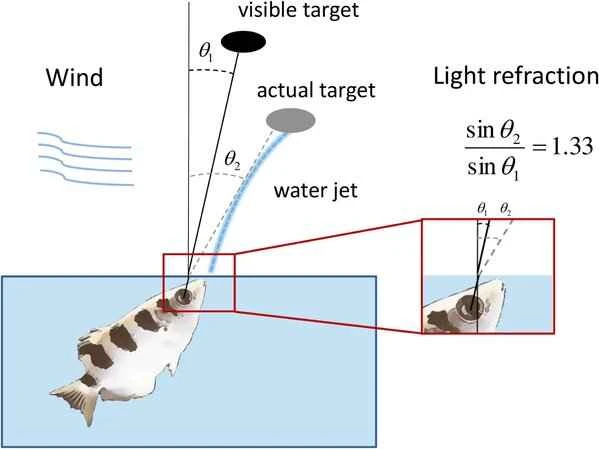
Research Objectives and Methods
This study is divided into two parts. The first part focuses on the morphology of the lips and tongue, assessing whether they play a role in the aiming process. Previous studies suggested that bowgunfish might rely on their lips or tongue to adjust the direction of their jets, but we found that bowgunfish do not have movable lips, and their tongues are too short to influence the direction of the water flow. Through anatomical studies of the bowgunfish's mouth, we confirmed that the tongue cannot extend forward or reach the front of the mouth.
The second part investigated how bowgunfish accurately aim at their targets and whether they engage in fine-tuning aiming behavior. Due to their compact bodies, bowgunfish can only aim by adjusting their body orientation. Previous research has also shown that bowgunfish adjust their body posture during aiming. We hypothesized, through measurements of the mouth angle, that if the mouth angle remains constant, there should be a strong correlation between the fish's body angle and the jetting angle. The required aiming fine-tuning varies with target distance, so we verified this hypothesis by conducting tests at different target distances.
Furthermore, we investigated how bowgunfish use visual cues to precisely aim at targets. Unlike other fish, bowgunfish can not only move their eyes horizontally and vertically, but they can also rotate their eyeballs autonomously without moving their bodies (eye torsion). This eye torsion phenomenon is relatively common in bowgunfish and has been mentioned by Lü Ling (1955) and Dill (1983). We investigated whether eye torsion is related to aiming behavior by measuring the eye angle (the angle between the eye axis and the body axis).
Research Results and Discussion
We found that the bowgunfish's tongue cannot play a fine-tuning role in aiming, as some researchers have suggested, because the tongue is too short and lacks mobility. We also confirmed that the bowgunfish's mouth angle is an individual characteristic, remaining largely unchanged even as the target distance changes. Through experiments, we also observed that the bowgunfish's body rotates around a fixed eyeball, and the eye angle also showed some individual variation, although the variation in eyeball angle was more significant than that in mouth angle.
The results of this study indicate that the aiming behavior of bowgunfish relies primarily on adjustments to body posture, rather than fine-tuning of the mouth or tongue. Eye rotation is closely related to aiming behavior, but it is not the sole determining factor. With further research, we expect to gain a clearer understanding of how bowgunfish precisely capture aerial prey by adjusting their body and eye posture.
Distribution area of bowfish ( swordfish)
The bowfish ( swordfish) is native to Southeast Asia, northern Australia, and some surrounding islands. They inhabit a variety of aquatic environments, including mangroves, coastal areas, and freshwater or brackish water rivers. Bowfish typically live in shallow waters , where they can easily spot and shoot prey on the surface.
Interesting facts about bowfish ( swordfish) :
Social fish : Bowfish typically live in small groups and occasionally cooperate to hunt larger prey or drive away predators. They also use water jets in social environments, especially when competing for food or territory.
Intelligence : Bowfish ( swordfish) excel at problem-solving. Researchers have trained them to shoot water at specific targets or respond to different signals, demonstrating their intelligence and adaptability.
More than just hunting : In addition to preying, bowfish ( swordfish) also occasionally engage in playful behavior with water currents or explore their surroundings.
The bowfish ( swordfish) is a fascinating example in nature of how animals evolve unique survival skills. Through precise water jet shooting, the bowfish not only hunts but also protects itself, enhancing its survival abilities through complex learning and adaptation processes. As a "sharpshooter among fish," the bowfish 's unique water jet shooting behavior fascinates researchers and provides valuable material for ethology. Whether for hunting, defense, or recreation, the bowfish demonstrates the wonder and wisdom of nature.