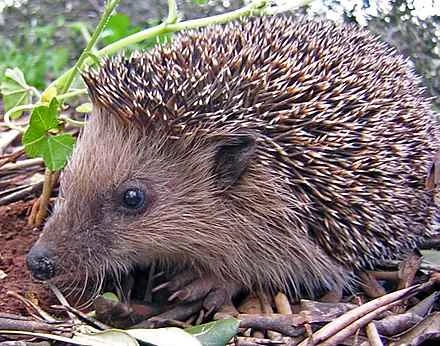
Hedgehogs (scientific name: Erinaceidae) are small mammals belonging to the subfamily Erinaceinae in nature. They are known for the sharp spines covering their backs, which they curl into a ball to expose when threatened, thus protecting themselves from predators.
Basic features
Appearance : The most distinctive feature of hedgehogs is the quills that cover their backs; these quills are actually modified fur. They are relatively small, typically 20-30 centimeters in length, and their weight can range from a few hundred grams to over 1 kilogram.
Skin and spines : A hedgehog's spines can stand upright under the control of muscles. When a hedgehog encounters danger, special muscles cause the spines to stand up, forming a ball to defend against enemies.
Facial features and senses : Hedgehogs have very keen senses of smell and hearing, but relatively weak vision.
Lifestyle
Diet : Hedgehogs are omnivorous, mainly feeding on insects, but also eating worms, small mollusks, eggs, small vertebrates, and some plants.
Activity time : Some hedgehogs are nocturnal animals, resting in the grass or tree holes during the day and foraging at night.
Lifestyle : Hedgehogs are typically solitary, only seeking mates during the breeding season. They are highly territorial and will exhibit aggression towards intruders.
Hibernation : In cold climates, hedgehogs hibernate. Before hibernating, hedgehogs eat plenty of food to store energy as fat to survive the winter.
Reproduction and growth
Reproduction : Hedgehogs typically breed from late spring to early summer. The gestation period is usually 4 to 6 weeks.
Giving birth : A female hedgehog can give birth to 2 to 10 offspring at a time, but usually 3 to 5.
Nurturing : Newborn cubs are weak and have soft spines. Around 4 to 6 weeks old, the cubs become independent and grow mature spines in a short time.
distributed
Habitat : Hedgehogs are widely distributed in Europe, Asia, Africa, and New Zealand. Their habitats include forests, grasslands, bushes, and gardens.
Adaptability : Hedgehogs can adapt well to different environments, including human gardens and suburbs.
Current situation and protection
Conservation Status : The populations of many hedgehog species are relatively stable, but some species are threatened by habitat loss and road traffic.
Relationship with humans : Hedgehogs are generally considered beneficial animals because they can help control the number of garden pests.
Interaction with humans
While hedgehogs are generally harmless to humans and animals, in some areas, particularly in those introduced as non-native species like New Zealand, they can cause harm to native insects and small animals. However, due to their adorable appearance, they are also kept as pets in some regions. If keeping a hedgehog as a pet, special attention needs to be paid to their specific diet and lifestyle habits, as well as their requirements for temperature and humidity.