Kangaroos are marsupials, mainly distributed in Australia, Tasmania, and neighboring islands. Below is detailed information about kangaroos and their habits:
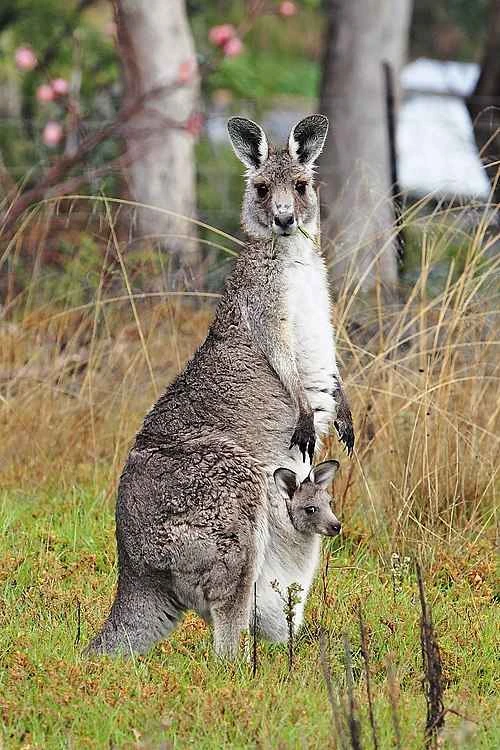
Species classification
The Kangaroos family includes many different species of kangaroos, such as the giant kangaroo, the tree kangaroo, and the wallaby.
Appearance features
Size : Kangaroos vary greatly in size, with large kangaroos reaching up to 1.8 meters in height and small kangaroos around 40 centimeters.
Hind limbs : Long and strong, adapted for jumping, forming the basis of the kangaroo's powerful speed and agile leaping.
Pouch : Female kangaroos have a pouch (also called a sac) that can hold newborn fetuses and provide nourishment and protection.
distributed
Kangaroos are mainly distributed in Australia and surrounding islands, while some species, such as the tree kangaroo, are also found in New Guinea and parts of Indonesia.
Habitat
They prefer to inhabit various terrains such as open grasslands, deserts, meadows, and forests.
Dietary habits
Kangaroos primarily feed on plants, including various herbs, leaves, buds, and nuts.
Their diets are also influenced by habitat and seasonal changes.
Social structure
Kangaroos are typically social animals, forming gregarious groups. They gather together to forage, rest, and reproduce.
Reproduction and reproductive behavior
Female kangaroos have a pouch that opens forward to hold and nurture their young.
Kangaroo breeding season is influenced by food and climate, and generally, it occurs during the grassland harvest season.
Survival threat
Kangaroos have natural predators including predatory lions, leopards, crocodiles, and human activities also pose a threat to their survival.
Habitat destruction, climate change, and hunting all impact kangaroo numbers and distribution.
Relationship with humans
Kangaroos play an important role in the tourism industry in Australia and other countries, and are regarded as a national symbol and tourism resource.
Some kangaroo species are protected as protected species and are protected by relevant conservation policies.
In summary, kangaroos are unique and iconic animals of Australia and the surrounding region, possessing distinctive physiological characteristics and social behaviors. They play a vital role in maintaining the balance of the local ecosystem and in tourism.