The largest animal on Earth is the blue whale. A marine mammal belonging to the suborder Baleen whales, it has four subspecies. The blue whale is considered the largest known animal to have ever lived on Earth, reaching lengths of up to 33 meters and weighing up to 181 tons. It has a slender body and a bluish-gray back, though it may appear lighter in the water. Like other baleen whales, blue whales primarily feed on small crustaceans (such as krill) and small fish, and sometimes squid. They typically forage at depths exceeding 100 meters during the day and only surface at night to feed. Blue whales begin mating in late autumn and continue until late winter. Females usually give birth every 2-3 years, with a gestation period of 10-12 months, typically in early winter. They are found in all four oceans.
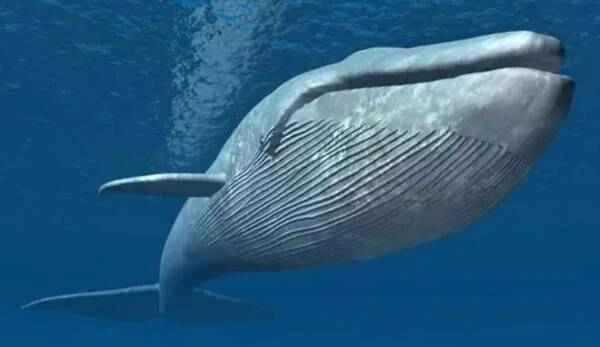
The blue whale is not only the largest whale but also the largest living animal and the largest mammal ever discovered. It typically measures 2200-3300 cm in length and weighs 150,000-180,000 kg, meaning its weight is equivalent to more than 25 African elephants or the combined weight of 2000-3000 people. Fortunately, due to ocean buoyancy, it doesn't need to exert as much effort to support its weight as land animals, and its massive body also helps maintain a constant body temperature. The blue whale's entire body is pale blue or grayish-blue, with light-colored fine markings on its back, white spots on its chest, more than 20 folds, and a folded abdomen extending to the navel with ochre-yellow spots. Females have mammary grooves on either side of their genital opening, containing slender nipples. The head is relatively small and flat, with two blowholes located on top. It has a wide snout, a large mouth without teeth, and a broad, arched upper jaw covered with black barbels, up to 300-400 on each side. It measures 90-110 cm in length and 50-60 cm in width. A significant amount of wax accumulates in its eardrums each year; the thickness of this wax indicates its age. On its upper jaw is a white callus, formerly a place where hair grew. Later, the hair degenerated, leaving a wart-like growth that became a breeding ground for parasites. Because this callus varies from individual to individual, resembling different shaped "hats," it can be used to distinguish different individuals. The dorsal fin is particularly short, less than 1.5% of the body length. The flippers are also not very long, about 4 meters in length, with four toes. The posterior edge of the flipper lacks a wavy notch. The tail is broad and flat. Its body is streamlined and looks like a razor, hence the name "razor whale".
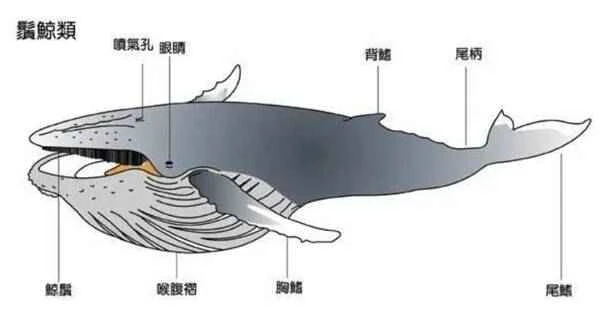
The bays inhabited by blue whales are largely fed by rivers carrying abundant organic matter, making the water extremely fertile and promoting the proliferation of plankton. This dense plankton, in turn, attracts large swarms of krill with their shimmering, diamond-blue bodies. Blue whales have four stomachs, the first being an enlarged portion of the esophagus, giving them an enormous appetite. They can swallow approximately 2 million krill at a time, consuming 4,000-8,000 kilograms daily. They experience hunger if their stomach contains less than 2,000 kilograms of food. Krill are the most abundant animals on Earth, widely distributed in the Arctic and Antarctic seas. It is precisely because of this abundant food source, and the lack of weight restrictions in the water, that blue whales can grow to such enormous sizes. It spends most of its time swimming with its mouth wide open among dense plankton. Its two rows of baleen plates act like sieves, and its belly has many accordion-like folds that can expand and contract, allowing it to swallow seawater and krill together. Then, it closes its mouth, letting the seawater drain through the baleen plates, filtering out small shrimp and fish, which it then consumes. Blue whales also feed on other shrimp, small fish, jellyfish, diatoms, and various plankton. Comparatively, blue whales living in northern waters are smaller than those living near Antarctica, which is generally believed to be closely related to the variety and quantity of their diet.
Blue whales feed on plankton, primarily krill. A single blue whale consumes 2-5 tons of food daily. They swim at speeds of 2-6 km/h while feeding, 5-33 km/h during migration, and up to 20-48 km/h when being chased. They typically perform 10-20 short dives followed by a deep dive, with shallow dives spaced 12-20 seconds apart and deep dives lasting 10-30 minutes. Their spouts are narrow and straight, reaching heights of 6-12 meters. Krill are the primary food source for blue whales, but the specific species they consume vary depending on the ocean region. In the North Atlantic, northern krill are their main food source, while in Antarctica, Antarctic krill are. Blue whales usually prey on the densest krill shoals they can find, meaning they need to forage in deep water (over 100 meters) during the day and only surface at night to feed. A blue whale's dive typically lasts about 10 minutes during a feeding period. Diving for 20 minutes is not uncommon; the longest recorded dive is 36 minutes (Sears, 1998). During a feeding frenzy, blue whales ingest a large swarm of krill along with a significant amount of seawater. They then squeeze their abdominal cavity and tongue to expel the seawater through their baleen plates. Once the seawater is expelled from their mouths, the blue whale swallows the remaining krill that cannot pass through the baleen plates.
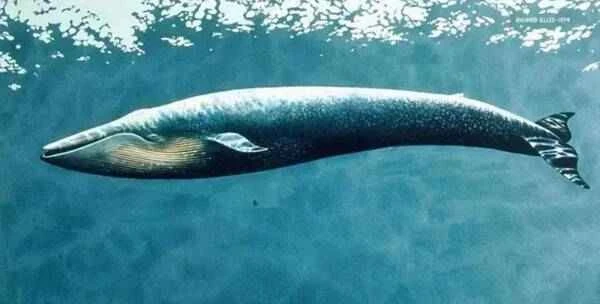
Despite its enormous size and slow, often motionless movements, it can float and sink freely in the water. Its tail swings flexibly, serving as both a propulsion source and a rudder, allowing it to reach speeds of up to 28 kilometers per hour.
Blue whales are the loudest animals on Earth, using a low-frequency, deafening sound to communicate with their companions. This sound can sometimes exceed 180 decibels, louder than the sound of a jet plane taking off from a runway. A sensitive instrument has detected blue whale sounds from 80 kilometers away. Measurements taken at a distance of 1 meter from the blue whale, with a reference pressure of 1 millipascal, estimate that the sound at its source can reach 155-188 decibels. Even considering the different impedances of water and air, and different standard reference pressures, the equivalent sound range in air is still 89-122 decibels. For comparison, the sound of a pneumatic drill is approximately 100 decibels. However, humans may not perceive the blue whale as the loudest animal. The fundamental frequency of all blue whale populations is between 10 and 40 Hz, while the lowest frequency humans can perceive is 20 Hz. The duration of a blue whale's sound is 10-30 seconds. There are records of blue whales off the coast of Sri Lanka singing a four-note "song" for two minutes at a time, reminiscent of the song of a humpback whale. Researchers believe that because this phenomenon has not been observed in other populations, it may be unique to the B. m. brevicauda (dwarf) subspecies.