The Mexican axolotl (scientific name: *Ambystoma mexicanum*, English: Axolotl), also known as the "American axolotl" or "six-horned dinosaur," is an aquatic amphibian endemic to Mexico, famous for its unique appearance and larval stage. That is, even after reaching sexual maturity, it does not undergo metamorphosis to adapt to terrestrial life, retaining its aquatic larval form. The Mexican axolotl's "ageless appearance" has made it a subject of much scientific research. Although it is kept as a pet worldwide (especially in North America), its original habitat has been extensively exploited, with a habitable area of no more than 9 square kilometers. Currently, the native species is listed as critically endangered on the IUCN Red List.
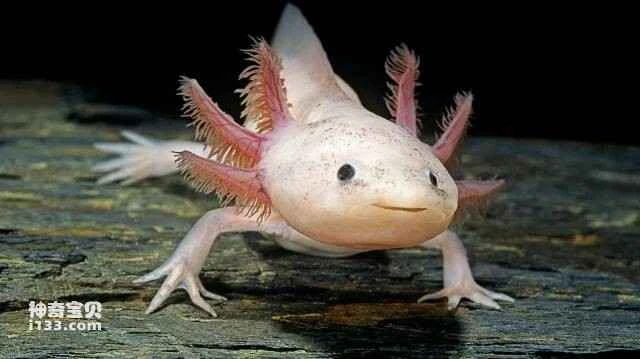
There are over 30 strains of Mexican axolotls. The following are common varieties available on the market, including improved types:
Albino axolotls: This is the most common type seen on the market. As the name suggests, they are completely milky white in appearance, with red external gills. They are generally called albino black-eyed axolotls, although some may have black horns and some black spots on their bodies.
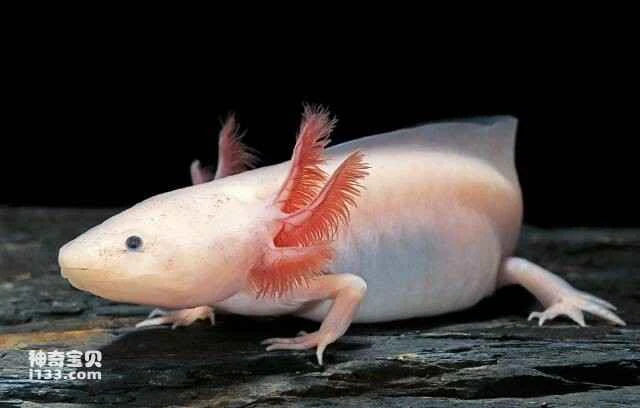
Albino axolotls: Their coloration is similar to albino axolotls, but their eyes are red, and their external gills are slightly orange. They are commonly known as albino red-eyed axolotls, and rarely have black spots on their bodies.
Black axolotl: A species with a more primitive coloration. Due to research and improvement, black individuals are relatively rare. The external gills are mostly black or purplish-black. Commonly known as "dark blue," juveniles reflect blue light. A glossy black is preferred. They usually do not have black spots on their bodies (only visible under strong light), and appear mostly pure black.
Gold-flake axolotl: Covered in bright white spots resembling gold flakes, with red external gills, it is the brightest-colored axolotl species. Common gold-flake varieties include the standard yellow-bodied gold-flake (yellow in color) and the platinum gold-flake (whitish in color), both of which have gold flakes distributed on their bodies.
Tiger axolotl: At first glance, its body color appears as yellowish-brown with black, but upon closer inspection, it is dark green, almost black in the absence of light. Its body is covered with black spots and stripes, and its outer cheeks are dark red. The wild species of tiger axolotl is a critically endangered species on the IUCN Red List of Threatened Species, native to Mexico, and is relatively rare in the market.
The following are strains that are not commonly found in the Taiwanese market, including improved versions:
Black-based axolotl with gold foil: Its body is covered with metallic gold spots, which gradually become larger, brighter, and clearer as it grows. Pure black with gold spots covering most of its horns and black gills. Commonly known as the leopard, its juvenile form is yellow with black spots, resembling tiger stripes but more golden. As it matures, its difference from the tiger-striped axolotl becomes more pronounced.
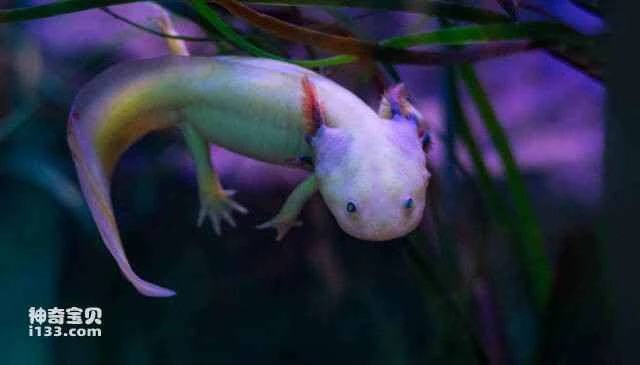
The following are special individuals and behaviors found on the market, and are not yet a stable breed:
White/yellow base with irregular black spots axolotls: The body is covered with irregular black patches of varying sizes. Sometimes only one part has black patterns, hence some people describe it as an ink splash or a cow. Usually, the base color is light, and the gills are mostly red.
Yellow/white background with irregular green spots hexagonal dinosaur: The body is covered with pure green spots, or green with black spots, and irregular color blocks of varying sizes. Because yellow background with green spots is reminiscent of seaweed and cheese, and white background with black and green spots is like seaweed rice balls, some people say that it looks like seaweed.
White-based hexagonal dinosaur with irregular yellow spots: Its body is covered in pure yellow spots, irregularly distributed, with a white background, red eyes, and a slightly pinkish body. Therefore, some people describe it as a pink leopard or a mottled flower.
Short-bodied axolotl: It has a large head and a small body, with a more rounded body shape. It is half the size of other common axolotls and becomes quite miniature as an adult, hence some people call it a dwarf.
Heterochromatic axolotl: Its eyes are different colors, one black and one red. Because it is very rare, some people call it heterochromia or heterochromia.
Yellow-backed, white-bodied axolotl: The upper half of its body is a bright pure yellow, while the lower half is covered in white patches. It has red eyes, orange cheeks, and its tail is covered with gold leaf, with a few scattered in other places, making it as eye-catching as a royal robe. Therefore, some people call it a golden dragon robe.
The two-tone axolotl: its body is divided into two very symmetrical colors, and sometimes its eyes may also be half black and half red.
Axolotl: Its six horns resembled those of a deer and branched outwards, making it very magnificent.